

For HR leaders, employment-based green card retention planning is not simply an immigration benefit decision. It is a workforce continuity decision. When a high-value foreign national employee is filling a role that is difficult to replace, the employer has to compare two real paths: invest in a permanent sponsorship strategy when the employee and role qualify, or accept the operational and financial risk of future turnover. Sponsorship does not guarantee that an employee will stay, and it does not guarantee immigration approval. But for the right employee, role, and business need, a permanent pathway may be more rational than repeatedly replacing experienced talent.
Retention Is a Business Question Before It Is an Immigration Question
A retention decision should start with the role, not the form number. HR and business leaders should ask what happens if this employee leaves. Does the company lose scarce technical knowledge, customer relationships, production continuity, project history, leadership capacity, or months of recruiting and training time? If the answer is yes, permanent sponsorship may deserve the same type of analysis the company would apply to succession planning, compensation, or other retention investments.
The reverse is also true. If the role is temporary, easy to fill, poorly defined, or no longer aligned with the organization’s long-term plan, sponsorship may not be the right tool. A retention lens is useful because it prevents the company from treating every foreign national employee the same.
What Turnover Actually Costs the Business
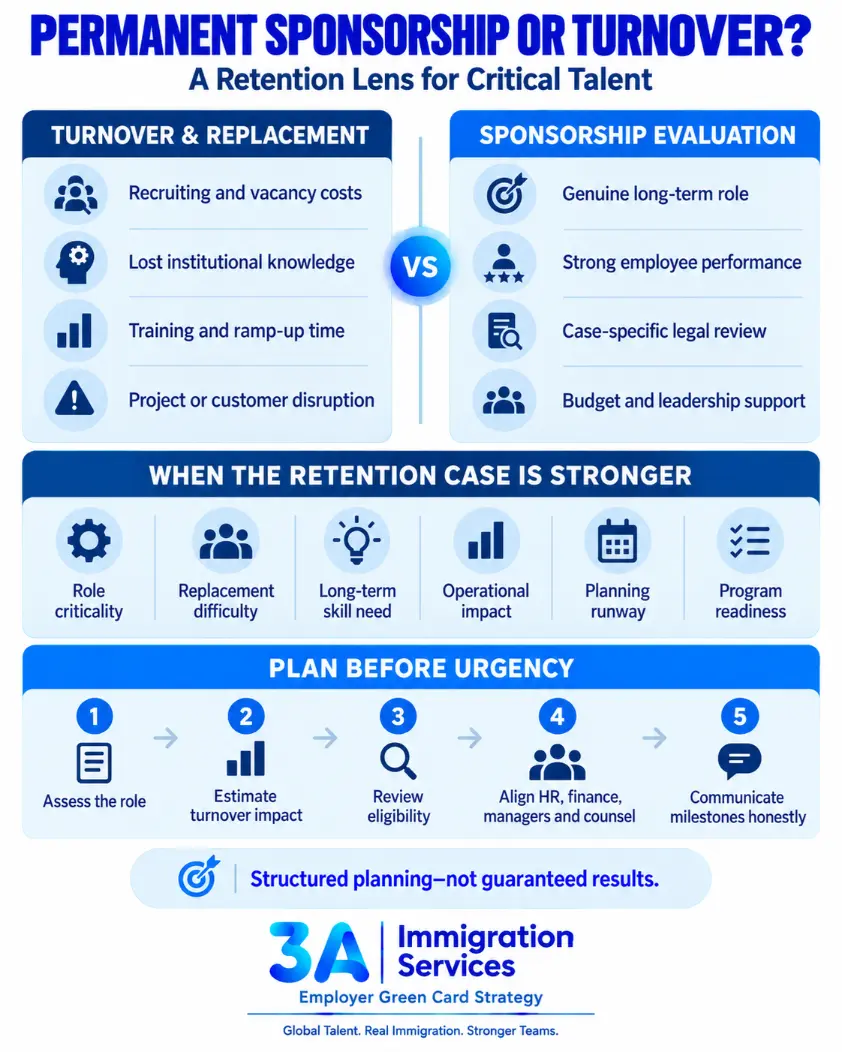
Turnover cost is broader than a recruiting invoice. Depending on the role, replacement can involve recruiter or agency fees, advertising, interview time, vacancy coverage, overtime, delayed projects, onboarding, training, lower productivity during ramp-up, manager time, and lost institutional knowledge. For customer-facing, technical, regulated, or operationally critical roles, the disruption can extend beyond the open position itself.
HR does not need a universal replacement-cost percentage to build the case. A stronger approach is to estimate the specific business impact for the role under consideration.
- Recruiting and sourcing cost for a realistic replacement.
- Expected time the position may remain open.
- Productivity lost while the role is vacant.
- Training and ramp-up time for a new employee.
- Manager and team time required to transfer knowledge.
- Potential project, production, customer, or compliance disruption.
- Risk that specialized knowledge leaves with the employee.
These costs do not automatically make sponsorship the better choice. They make the comparison more complete.
What Permanent Sponsorship Can Contribute to Retention
Employer-sponsored permanent residence can give an eligible employee a clearer long-term path than a temporary work-authorized strategy alone. That clarity may matter to employees making decisions about career growth, family stability, housing, travel, or whether to remain with an employer for the next several years.
The key word is may. Green card sponsorship should not be presented as a retention guarantee or as a contract that prevents an employee from leaving. Employees can still make career decisions, and immigration law includes portability rules in certain circumstances. The business value is that the employer can replace uncertainty with a structured long-term plan when the facts support one.
Permanent Sponsorship Is a Multi-Stage Process
For many employer-sponsored EB-2 and EB-3 cases, the process may include a Department of Labor permanent labor certification, commonly called PERM, followed by a Form I-140 immigrant petition and, when an immigrant visa number is available, adjustment of status or consular processing. Some categories follow different rules or do not require PERM.
The Department of Labor states that the employer—not the employee—is responsible for filing the permanent labor certification application. USCIS instructions for Form I-140 likewise explain that most employer-sponsored preference categories require a permanent job offer from a U.S. employer and that certain classifications require a labor certification.
Visa availability can add another planning variable. Employment-based preference categories are numerically limited, and the Department of State publishes a monthly Visa Bulletin showing when applicants may move forward based on category, priority date, and country of chargeability. That means an employer should not promise a single completion date.
Why Starting Earlier Can Reduce Retention Pressure
A common retention problem is waiting until the employee’s temporary-status timeline, personal circumstances, or job-market options create urgency. At that point, the employer may want a fast answer from a process that contains multiple government-controlled stages.
Earlier evaluation gives HR more room to determine whether the permanent role is real and long term, whether the employee appears to fit an appropriate category, what internal approvals are needed, and how the immigration timeline fits the workforce plan. It also gives the company time to communicate accurately instead of making promises under pressure.
When Sponsorship Has a Stronger Retention Case
Permanent sponsorship may deserve serious evaluation when several of the following conditions are present:
- The role is expected to remain a genuine long-term position.
- The employee has strong performance and specialized company knowledge.
- The position is difficult, slow, or expensive to refill.
- Turnover would disrupt important projects, customers, production, or operations.
- The company expects to need the skill set for years, not months.
- The employee’s temporary immigration strategy has a finite planning horizon.
- The employee has communicated that long-term immigration stability matters to career planning.
- The company has the budget, governance, and management commitment to support the process.
When Sponsorship May Not Be the Right Retention Tool
A permanent pathway should not become the default response to every turnover concern. It may be premature or inappropriate when the business need is temporary, performance is unresolved, the permanent role is not well defined, restructuring is likely, the company is unwilling to support the process through its required stages, or the employee may be better served by another immigration strategy.
The eligibility analysis is also separate from the retention analysis. A role can be strategically important and still require careful legal review to determine whether a particular employment-based category is available. HR should not promise sponsorship before qualified immigration counsel evaluates the case.
Build a Sponsorship Decision Framework HR Can Use Consistently
A written decision framework helps HR avoid one-off sponsorship promises and makes the process easier to explain to managers and employees. The framework can combine workforce criteria with legal review.
Workforce Criteria
- Role criticality and expected duration.
- Employee performance and business contribution.
- Replacement difficulty and labor-market availability.
- Knowledge concentration or succession risk.
- Projected recruiting, vacancy, and ramp-up cost.
- Business-unit commitment to the role.
Program Criteria
- Immigration eligibility based on case-specific legal review.
- Expected process stages and timing dependencies.
- Internal budget and fee approvals.
- Employer responsibilities for PERM when applicable.
- Document readiness and manager participation.
- Employee communication and expectation-setting.
- Contingency planning if the case or business circumstances change.

Do Not Treat Sponsorship as a Retention Contract
One of the most important HR boundaries is communication. The company can explain that it is willing to evaluate or support a permanent pathway, but it should avoid promising approval, a fixed completion date, or a guaranteed period of employee retention.
The September 2026 Visa Bulletin illustrates why timelines require qualification: some employment-based categories are current for some countries while others have cutoff dates or can become unavailable. Visa availability can advance or retrogress. In addition, government processing, recruitment requirements, audits, job changes, and case facts can affect the path.
A better employee message is: the company is investing in a structured long-term process, will communicate milestones honestly, and will obtain case-specific guidance as conditions change.
Measure Retention Outcomes Without Overclaiming ROI
If sponsorship is part of a retention strategy, HR can track whether the program supports workforce stability over time. Useful measures include tenure of sponsored employees, critical-role vacancy rates, replacement cost, internal promotion, case initiation timing, employee communication milestones, and regrettable turnover among foreign national employees.
Do not attribute every retention outcome to immigration sponsorship. Compensation, management quality, career growth, workload, location, family needs, and the external labor market also influence whether employees stay. The objective is to understand whether permanent pathways are one effective component of a broader retention system.
A Practical Retention Review Checklist
- Identify foreign national employees in roles the business expects to need long term.
- Rank the roles by replacement difficulty and operational impact.
- Estimate realistic replacement, vacancy, and ramp-up costs.
- Review current immigration status and planning horizon with qualified counsel.
- Determine whether an employment-based permanent category may be appropriate.
- Confirm that the permanent job and business need are genuine and supportable.
- Assign HR, manager, finance, and legal responsibilities.
- Set an internal decision date before immigration urgency develops.
- Communicate what the company will and will not promise.
- Review progress and retention risk at recurring workforce-planning intervals.
How 3A Immigration Services Fits the Retention Strategy
3A Immigration Services works with U.S. employers on workforce immigration, employer-sponsored permanent residence, and broader global talent planning. Employers can review the 3A Immigration Services Green Card program, read its guidance on the green card sponsorship timeline, or request a consultation when a long-term employee or critical role needs a structured sponsorship review.
The goal is not to sponsor every employee. It is to identify where permanent pathways fit the company’s long-term workforce needs, evaluate eligibility and timing early, and create a consistent process for HR, managers, finance, and immigration counsel.
FAQ: Employment-Based Green Card Retention
Does green card sponsorship guarantee that an employee will stay?
No. Sponsorship does not guarantee retention, and it does not guarantee immigration approval. It may support long-term workforce stability when the employee, role, and business need are a strong fit.
When should HR consider permanent sponsorship?
Consider evaluation when the role is genuinely long term, the employee is a strong contributor, replacement would be difficult or disruptive, and the company has enough planning runway to evaluate the immigration path before urgency develops.
Is PERM required for every employment-based green card?
No. Many EB-2 and EB-3 employer-sponsored cases use PERM, but some employment-based categories have different requirements or may not require labor certification. Case-specific legal review is necessary.
How should employers compare sponsorship with turnover?
Compare sponsorship costs and internal effort with realistic recruiting, vacancy, onboarding, ramp-up, productivity, and continuity costs. The comparison should also consider role criticality and the company’s long-term need for the employee’s skills.
How early should a company start planning?
There is no universal start date. Because permanent sponsorship can involve multiple dependent stages and visa availability, employers should evaluate critical employees well before temporary-status deadlines or retention pressure creates an urgent business decision.
The Bottom Line
Permanent sponsorship can be a powerful retention and workforce-continuity tool when the company has a genuine long-term role, a high-value employee, and a business case that compares favorably with turnover. It is not a guarantee, and it should not replace good management, competitive compensation, or career development.
The practical HR question is whether the organization would rather plan early to retain critical talent or wait until replacement risk becomes urgent. A consistent sponsorship framework gives the company a way to make that decision deliberately, with legal eligibility, workforce needs, cost, timing, and employee expectations evaluated together.
Disclaimer: This article provides general educational information about employment-based immigration and workforce planning and is not legal advice. Employment-based permanent-residence eligibility, PERM requirements, visa availability, processing times, priority dates, portability, fees, and strategy vary by employee, employer, category, country of chargeability, and current law or agency policy. Employers should obtain case-specific advice from qualified immigration counsel before making sponsorship commitments or employment decisions.
Official Resources
- U.S. Department of Labor – Permanent Labor Certification (PERM)
- USCIS – Form I-140, Immigrant Petition for Alien Workers
- U.S. Department of State – Visa Bulletin
RELATED LINK: U.S. Department of Labor – Permanent Labor Certification (PERM)