
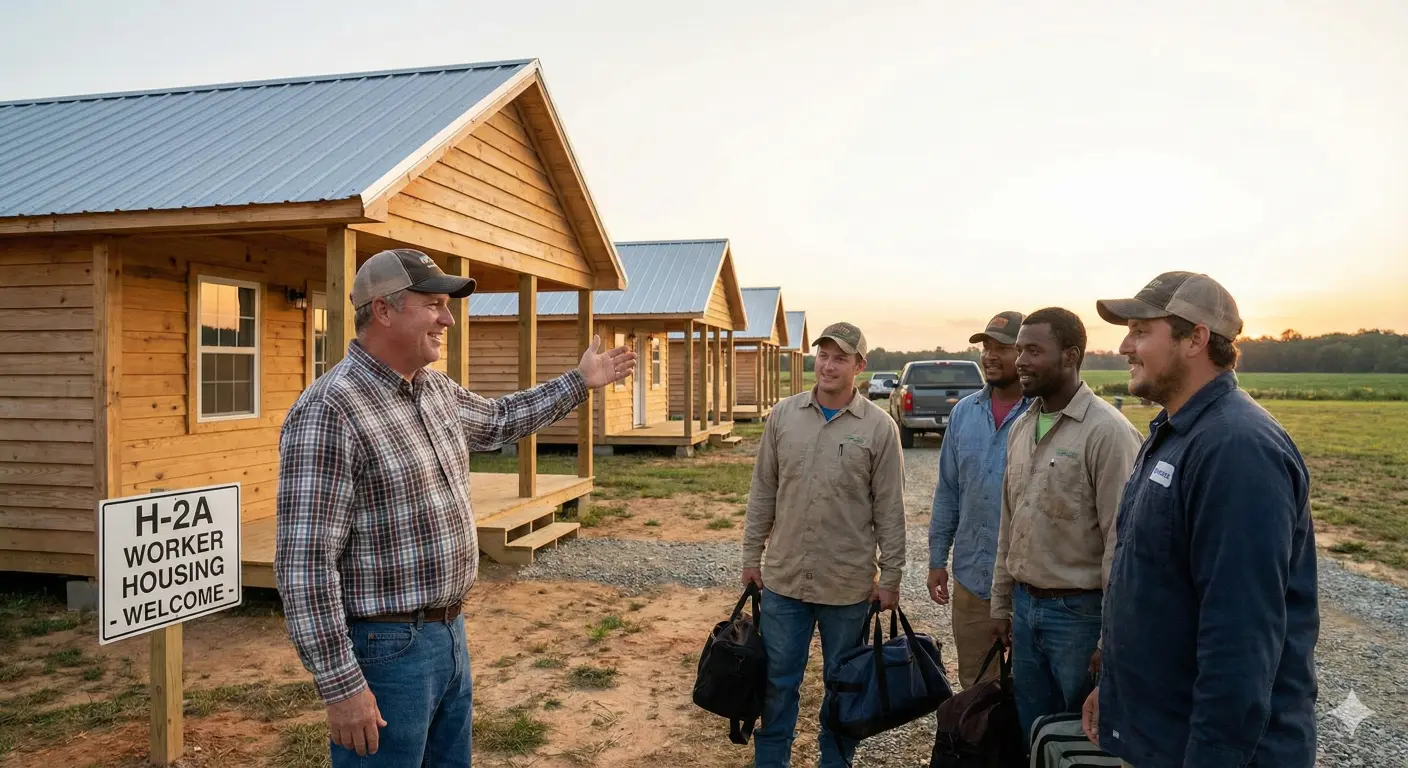
If you’re the person holding together housing and transportation for your H-2A workers, you probably don’t need another reminder that it’s a lot. Housing inspections, bus routes, arrivals, vendors, maintenance, worker complaints, “one more thing” from leadership—plus everything else on your plate.
Most H-2A programs don’t fall apart because of a single missed form. They struggle because housing and transport live in everyone’s job… and no one’s system. When inspections, worker complaints, or last-minute scrambling become normal, it’s a sign that housing and transport are being treated as a set of tasks instead of a structured process.
This guide is designed for you—the housing and transportation coordinator or the unofficial “catch-all” person. It walks through how to turn H-2A housing compliance and transportation coordination into a simple, owner-driven system you can repeat every season, with clearer responsibilities and fewer surprises.
Why H-2A Housing and Transport Can’t Be “Just Logistics”
It’s easy for leadership to think of housing and transport as logistics: book the beds, schedule the vans, pass the inspection, done.
You know it’s not that simple.
Housing and transport tasks are usually spread across HR, operations, site supervisors, vendors, and sometimes landlords or third-party transportation companies. When no one has the full picture, gaps are almost guaranteed.
Here’s how that usually shows up:
- Last-minute fixes. Housing isn’t truly ready until the week workers arrive. Transport routes change at the last second. You’re buying cleaning supplies or bedding on the fly because something was missed.
- Inconsistent documentation. One season you keep photos and logs; the next, they’re scattered across email threads, texts, or someone’s personal notes. When someone asks, “Do we have proof we fixed that issue?” you’re digging through inboxes.
- Worker frustration. Buses run late. A maintenance issue lingers. Workers don’t know whom to talk to—so they either say nothing or escalate directly to an outside contact.
- Inspection anxiety. Every time there’s an inspection or a hint of worker complaints, stress spikes because you’re not fully confident in what’s been documented or who’s responsible for what.
The result: even if you technically “get it done” each season, it feels like you’re reinventing the wheel. The good news is that the fix usually isn’t a bigger team—it’s a clearer system with defined owners and checkpoints.
The H-2A Housing & Transport Compliance System at a Glance
Instead of thinking about individual tasks, it helps to picture housing and transport as a mini compliance system that works alongside your overall H-2A program.
At a high level, that system has three core pieces:
- Standards: What needs to be true.
- Owners: Who is responsible for making it true.
- Checkpoints: When and how you verify that it remains true.
When these three pieces are defined—even in a simple, practical way—you move from “we hope it’s okay” to “we have a process we can explain, repeat, and improve.”
A “good” system doesn’t have to be complicated. It should:
- Work the same way every season, with clear room for improvements.
- Be ready for scrutiny: if someone asks, “How do you handle X?” you can show the process and documentation.
- Survive turnover or absences: if one key person leaves, the program doesn’t fall apart.
Standards, Owners, Checkpoints — A Simple Map
You don’t need legal citations to build this map. You need clarity.
- Standards:
These are the conditions and practices you aim to maintain for housing and transportation. They’re informed by applicable rules, guidance, and your own internal expectations. Think: “Housing is clean, safe, and maintained,” “Transport is timely and reliable,” “Workers know how to report issues.” - Owners:
These are the people who are accountable—not necessarily the only ones who do the work, but the ones who make sure it happens. For example, “Housing Coordinator owns pre-season readiness” or “Site Supervisor owns daily transport checks.” - Checkpoints:
These are the specific moments when you stop and verify: “Is the standard actually being met?” Checkpoints can be inspections, walkthroughs, sign-offs, or structured conversations, but they need to be intentional and documented.
Once you’ve named your standards, owners, and checkpoints, you’re ready to ask the most important question: is any of this written down and followed in practice?
Quick Checklist: Is Your H-2A Housing and Transport Systemized?
Use this checklist as a quick, honest self-assessment. You don’t need to pass every item today. The goal is to see where your system is strong and where risk is hiding.
Mark each item as “solid,” “in progress,” or “needs work.”
- ☐ There is a clear owner for housing prep and inspections (pre-season and during the season).
- ☐ There is a clear owner for transportation planning and daily operations (routes, schedules, changes).
- ☐ We have a written process for worker arrival, move-in, and orientation, including how we communicate housing rules and transport routines.
- ☐ We have a defined process for maintenance requests and issue escalation—workers know how to report problems and we know how to track and prioritize them.
- ☐ We follow a documented schedule for routine housing checks (not just one-time inspections).
- ☐ We have documented transport routes, schedules, and contingency plans for delays, breakdowns, or weather disruptions.
- ☐ We use centralized record-keeping for inspections, issues, and fixes—so we can quickly show what happened and when.
Any “needs work” checkmarks are not failures—they’re roadmap items. In the rest of the article, you’ll see how to turn those weak spots into part of a functioning H-2A compliance system for housing and transport.
Mapping Responsibilities: Who Owns What (and When)
In many H-2A programs, the unofficial motto is “everyone helps.” That sounds cooperative, but it often means nobody is clearly accountable.
“Everyone helps” is not the same as “ownership.” Ownership answers:
- Who is responsible for making sure this gets done?
- Who is the point of contact if there’s a question or a problem?
- Who signs off that the standard is being met?
You don’t need job titles that match perfectly. What matters is that every part of the housing and transport process has an owner.
Common roles might include:
- An H-2A housing and transportation coordinator (formal or informal).
- HR or recruiting staff who manage arrivals and initial communication.
- Site supervisors who oversee daily work and worker transport.
- Facilities or maintenance staff.
- External vendors, landlords, or transportation companies.
The key is to map responsibilities across time—before, during, and after the season for housing; and daily vs. exception handling for transport.
Housing Ownership: Before, During, and After the Season
Think of housing in three phases, and assign owners for each.
Before the season
- Who ensures housing is ready before the first worker arrives?
- Who coordinates any required inspections or walkthroughs?
- Who checks basics like beds, linens, kitchen equipment, smoke detectors, and common areas?
This might be your housing coordinator working with maintenance and any landlords. The important part: one person is accountable for confirming readiness and capturing proof (photos, checklists, notes).
During the season
- Who responds when workers report a housing issue?
- Who decides what is urgent, what can wait, and how to communicate timelines?
- Who documents issues and fixes, so you have a record beyond “we remembered to do it”?
Ownership here is often shared between site supervisors, maintenance, and HR. But someone needs to own the flow: issue comes in → it’s logged → it’s assigned → it’s resolved → it’s confirmed.
After the season
- Who closes out housing at the end of the season?
- Who conducts move-out walkthroughs and notes any repairs or changes needed before the next season?
- Who updates your housing SOP based on what you learned?
This is where you convert “we’ll remember that for next year” into actual updates to your process.
Transport Ownership: Daily Operations and Exceptions
Transport is similar: there’s everyday routine and there are exceptions.
Daily operations
- Who designs and maintains the routes and schedules?
- Who ensures drivers, vehicles, and workers all have the same information?
- Who checks that buses or vans are arriving and departing on time, and that capacities are realistic?
Often, a transportation lead or site supervisor works with a vendor or in-house drivers. Name that owner and write it down.
Exceptions and disruptions
- Who decides what happens if a vehicle breaks down or a driver is out?
- Who communicates delays to workers and supervisors?
- Who logs these incidents and follows up if patterns emerge?
Clear ownership here keeps a “bad morning” from turning into a bigger pattern of frustration or complaints.
Checkpoints That Actually Catch Problems Early
A checkpoint is more than “we’ll keep an eye on it.” It’s a specific, scheduled moment when you verify that standards are being met—and you document what you see.
For H-2A housing and transport, you might build checkpoints like these:
For housing
- Pre-season inspection: Before anyone arrives, you or your owner walk each unit using a simple checklist and take photos.
- First-week follow-up: Once workers move in, you do a quick check—are there any issues they noticed that weren’t obvious before arrival?
- Mid-season spot checks: Short, periodic walkthroughs to confirm that conditions are being maintained and to catch emerging problems.
- Pre-move-out walk-throughs: Identify damages, repairs, and improvements needed before the next season.
For transport
- First-week route validation: Ride along or do a quick review of routes and timing once they’re in full use. Are workers arriving on time? Are there chronic bottlenecks?
- Regular schedule checks: Weekly or bi-weekly review of actual departure/arrival times versus planned times.
- Periodic feedback from workers and supervisors: Short, structured feedback on whether transport is reliable and safe.
A useful contrarian truth: one annual inspection or one-time review is not enough to manage ongoing risk. Conditions change. Vehicles break down. Workers experience the day-to-day reality.
Checkpoints help you catch issues while they are still small and manageable. They also create a record you can point to if someone asks, “What have you been doing to monitor housing and transport?”
Common Failure Modes in H-2A Housing and Transport Systems
Even programs with good intentions run into predictable problems. Recognizing these patterns helps you prevent them.
Here are some common failure modes and how they usually show up:
Over-reliance on memory or “the way we did it last year.”
- A key person remembers everything… until they don’t.
- Details like special room assignments, route tweaks, or last year’s issues never make it into a shared system.
- When staff changes, institutional memory disappears.
Assuming vendors or landlords are “handling compliance.”
- You rely on a landlord or transport company to meet all standards, but there’s no clear agreement on expectations or documentation.
- Issues with housing conditions or vehicle readiness are discovered only after workers report them.
- No one internally is checking whether external partners are actually meeting your standards.
No clear way for workers to report issues.
- Workers don’t know who to talk to, or they fear that complaining might cause problems for them.
- Problems simmer quietly until they become serious—or reach outside channels.
- You hear about issues late, with less time and flexibility to address them.
Scattered documentation.
- Photos on one person’s phone, inspection notes in someone else’s email, maintenance logs on paper.
- When leadership, auditors, or investigators ask for records, it takes days to pull things together.
- Even internally, you can’t easily see patterns across seasons or sites.
Each of these increases operational risk. They make it harder to respond quickly, show your work, and demonstrate that your H-2A housing and transportation requirements are being taken seriously.
The solution isn’t perfection. It’s designing your system so these failure modes are less likely and easier to recover from.
Turning Your Checklist into a Living SOP
You already took the first step by walking through the checklist. Now the goal is to convert that into a simple standard operating procedure (SOP) that people can actually follow.
Here’s a practical way to do it:
- Start with the phases and owners.
Take housing and transport separately. For each one, list what happens before, during, and after the season (for housing) and daily vs. exceptions (for transport). For every step, write down the owner. - Add timelines and checkpoints.
For each step, ask: “When should this happen?” and “How do we verify it?” For example, “Pre-season housing inspection—two weeks before arrivals; inspection checklist and photo folder completed.” - Define documentation expectations.
Decide what “proof” looks like: a signed checklist, photos in a shared folder, notes in a log, or all of the above. Keep it as simple as possible while still useful. - Make the SOP easy to find.
Put it where people already go for information—shared drive, internal portal, or a binder on-site. The test: could a new supervisor find and understand it on their first week? - Plan a short post-season review.
Set a date after the season ends to ask: What worked? What didn’t? What needs to change in the SOP? Capture those lessons while they’re fresh.
Simple Ways to Document Without Creating Extra Work
Documentation doesn’t need to be elaborate. It just needs to be consistent and centralized.
Some low-friction ideas:
- Checklists with photos.
A short checklist (digital or paper) plus a set of photos stored in a shared folder can go a long way toward showing what conditions looked like at a given time. - Basic logs.
A simple spreadsheet or shared document for maintenance requests and transport issues: date, issue, owner, action taken, date resolved. - Shared notes from check-ins.
After a walkthrough or feedback session, record a brief summary in a shared place rather than keeping notes in your personal notebook. - Templates.
Reuse the same inspection and incident templates each season to make year-to-year comparisons easier.
The goal isn’t to create more work—it’s to make the work you already do visible and defensible.
Partnering with a Legal and Workforce Team for Higher-Risk Areas
There’s a natural boundary between what your internal operations team can handle and where specialized legal or workforce guidance adds value.
Your team can:
- Design the day-to-day housing and transport processes.
- Assign owners and create practical checkpoints.
- Implement documentation practices and issue-handling routines.
Specialized immigration and workforce teams, like 3A Immigration Services, can help you:
- Look at your housing and transport processes in the context of your overall H-2A program.
- Identify higher-risk practices and blind spots, based on experience with other employers and evolving expectations.
- Plan changes to your model in a way that considers both operations and immigration strategy.
When you’re ready for a deeper review, it helps to bring:
- Any existing checklists or inspection forms you use.
- Examples of your housing and transport logs (even if they’re informal).
- A description of how workers report issues today.
- A clear list of what worries you most—inspection risk, worker complaints, documentation, or something else.
If your H-2A housing compliance and transportation coordination still live mostly in emails and memory, you’re not alone. A free case evaluation can be a low-pressure way to validate what’s working and get practical guidance on the rest.
Next Steps: From Scramble to System
You don’t have to rebuild your program overnight. The biggest shift is in how you think about housing and transport—not as a stack of tasks, but as a system with standards, owners, and checkpoints.
Here’s a practical “start this week” list:
- Run through the checklist with your team.
Share the earlier checklist and ask everyone to mark where they feel confident and where they see gaps. Treat it as a reality check, not a test. - Assign clear owners for each part of housing and transport.
For every phase and key activity—pre-season housing prep, move-in, maintenance, daily transport, exceptions—write down a name. If there are shared responsibilities, clarify who has final accountability. - Identify one high-risk gap to fix first.
Maybe it’s the lack of a clear maintenance request process. Maybe it’s transport issue documentation. Choose one area and design one small improvement: a new log, a short checklist, a recurring checkpoint. - Schedule a quick review.
Put a 30-minute meeting on the calendar a few weeks into the season to ask: “Is our new step helping? What needs adjustment?”
If you want a second set of eyes on your system, you don’t need a crisis first.
If your housing and transport plan still lives in emails and memory, you’re not alone—and you don’t have to rebuild it from scratch. Our team at 3A Immigration Services helps employers look at H-2A housing and transport as part of a complete workforce and compliance strategy. Share how your current season works, where you see risk, and what you’d like to improve. Click below to request a Free Case Evaluation and get clear next steps for your program.
FAQ Content
- What does H-2A housing compliance actually cover for employers?
H-2A housing compliance generally relates to providing housing that meets applicable safety, health, and occupancy standards for eligible workers, along with meeting any related requirements tied to the program. The exact rules and enforcement approaches depend on the regulations and your specific situation, so it’s important to review official guidance and speak with qualified counsel for detailed obligations. - How can I tell if our current H-2A housing and transport setup is creating operational risk?
Warning signs include frequent last-minute fixes, unclear ownership for key tasks, worker complaints that repeat each season, and difficulty producing documentation when leadership or outsiders ask for it. If you rely heavily on memory, ad hoc communication, or assumptions about what vendors or landlords are handling, those are also indications that risk could be higher than it needs to be. - Who should own housing and transport responsibilities in an H-2A program?
There’s no one-size-fits-all structure, but every major piece of housing and transport should have a clearly named owner—often a housing and transportation coordinator, HR lead, site supervisor, or operations manager. Vendors, landlords, and drivers may handle specific tasks, but someone inside your organization should remain accountable for standards, communication, and follow-through. - What checkpoints should we build into our H-2A housing and transportation system each season?
Many employers find it useful to schedule pre-season housing inspections, first-week follow-up checks after workers arrive, and periodic mid-season walkthroughs. For transport, common checkpoints include an early review of routes and timing once they’re in full use, regular checks on schedule performance, and occasional structured feedback from workers and supervisors. The exact timing and frequency should match your scale and risk profile. - How can we document housing and transport activities without creating a lot of extra work?
Simple tools go a long way: short checklists with photos saved in a shared folder, basic logs for maintenance and transport issues, and brief written summaries from periodic check-ins. The key is to choose lightweight formats that your team will actually use and to keep records in a central location rather than scattered across emails and personal notes. - When should we bring in an immigration or workforce specialist to review our H-2A housing and transport processes?
It’s helpful to involve a specialist when you’re expanding your H-2A program, experiencing repeated issues, facing inspection concerns, or planning significant changes to your housing or transport model. An early review—before problems escalate—can help you spot gaps, prioritize fixes, and align your operations with your broader H-2A strategy.
If your H-2A housing and transport work feels like a constant scramble, you don’t have to sort it out alone.
Our team at 3A Immigration Services works with employers to view housing and transportation as part of a complete H-2A workforce strategy—not just a set of last-minute tasks. Share how your current season operates, where you see risk, and what you’d like to improve.
Get a Free Case Evaluation to:
- Walk through your existing housing and transport process with a specialist
- Identify one or two priority areas to stabilize first
- Discuss practical options for building a clearer, owner-driven system for future seasons
RELATED LINKS
-
U.S. Department of Labor — H-2A Fact Sheet (housing & transportation)
-
U.S. Department of Labor — H-2A Workers Overview (housing, transport, and worker protections)
-
U.S. Citizenship & Immigration Services — H-2A Temporary Agricultural Workers
-
U.S. Department of Labor (State-level page for H-2A Employers & Agents)