
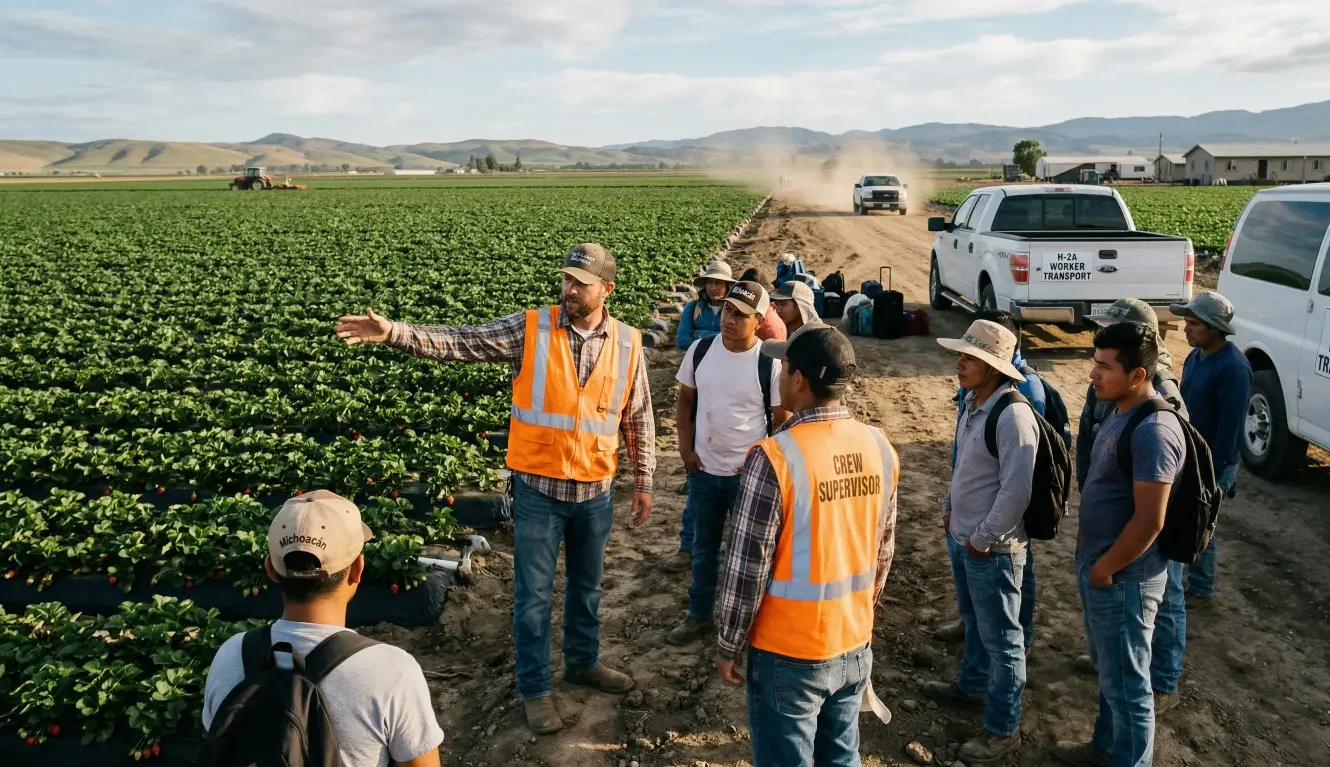
A harvest operation can look fully staffed on paper and still feel unstable in real life. Workers arrive. Housing is assigned. Transportation is scheduled. The job order is in motion. And yet, a few weeks into the season, the same problems start showing up: pace becomes inconsistent, avoidable conflicts start costing time, morale slips, and retention becomes harder than expected.
When that happens, it is tempting to diagnose the situation as a labor supply problem. Many employers do. They assume they need more workers, stricter oversight, or stronger incentives. Sometimes those things help at the margins. But in many operations, the deeper issue sits in the layer between management and the crew: the supervisor.
That is why H-2A crew supervisor influence matters more than many employers realize.
They do not just assign tasks or monitor attendance. They influence how instructions are understood, how pressure is managed, how problems get escalated, and how workers experience the day-to-day reality of the job. In practical terms, they help determine whether a crew stays steady or becomes unpredictable.
For a harvest manager dealing with uneven performance, housing friction, or mid-season turnover, this is an important shift in perspective. The question is not only whether the crew is large enough. It is whether the operation has equipped the people leading that crew to hold the system together.
The Real Problem: Why Fully Staffed Crews Still Underperform
Many staffing problems are not actually staffing problems. They are continuity problems.
A crew may have the right headcount and still underperform because continuity depends on more than labor availability. It depends on whether the workday starts on time, whether transportation is coordinated, whether workers know what success looks like that day, whether bottlenecks are addressed quickly, and whether frustrations are managed before they turn into disengagement. Those conditions are created or disrupted at the supervisory level.
This is especially important in H-2A settings, where crews often operate under tight seasonal pressure. There is little room for repeated confusion. If one day starts late because transportation was not coordinated well, that delay can affect output immediately. If housing issues go unresolved for too long, they can spill into crew morale. If instructions are unclear, pace drops and mistakes increase. None of that necessarily means workers are unwilling. It often means the operation is not being translated into daily execution effectively.
That is why “more workers” rarely fixes inconsistency by itself. Adding labor into a poorly coordinated system can even make it harder to manage. More people means more communication needs, more logistical complexity, more interpersonal dynamics, and more opportunities for confusion. If the person leading the crew is already stretched, unsupported, or unclear about expectations, adding people may increase pressure without improving results.
The real operational question is not only, “Do we have workers?” It is, “Can this crew function consistently, day after day, under the supervisor currently leading it?”
The Hidden Variable: Crew Supervisors as Operational Influencers
The word “supervisor” can make the role sound narrower than it really is. In the field, a crew supervisor often functions as an operational connector.
They connect management priorities to daily work. They connect housing and transportation realities to labor readiness. They connect cultural expectations, language, and work standards so that instructions are not just delivered, but understood. They also connect pressure from above with morale below. That is why they influence outcomes far beyond task assignment.
A strong supervisor helps make the day predictable. Workers know where to be, what to expect, how performance is being measured, and where to go when something is wrong. That predictability matters. It reduces friction, lowers avoidable tension, and allows the crew to focus on the work itself.
A weak supervisor creates noise in the system. Instructions change without explanation. Problems sit too long before they are escalated. Minor misunderstandings become personal conflicts. Workers stop trusting that practical issues will be handled fairly or quickly. Even if compensation is competitive and labor demand is strong, that environment makes retention harder.
This is where the “influencer” idea becomes useful. Not in the social media sense, but in the practical, operational sense. Crew supervisors influence mood, pace, trust, and accountability. Workers take cues from them constantly. If the supervisor is organized, calm, and consistent, the crew often reflects that. If the supervisor is reactive, unclear, or disconnected from what workers are experiencing, that instability spreads just as quickly.
In H-2A workforce management, that middle layer often determines whether the program feels stable on the ground or fragile under pressure.
Where Things Break Down: Diagnosing Supervisor-Driven Friction
When an operation starts feeling unstable, the symptoms often appear scattered. One day it looks like a transportation issue. Another day it seems like a morale problem. Then it turns into a communication issue. But these are often connected through the supervisor’s role.
Communication gaps are one of the most common breakdown points. Management may believe expectations are clear because they were communicated once. But what matters is whether those expectations were translated into simple, consistent direction at the crew level. If workers receive mixed messages, or if important updates are delivered too late, productivity suffers. Workers may appear resistant when the real issue is that the system is unclear.
Housing and transportation coordination can create a second layer of instability. A harvest manager may think of these as logistics, but workers experience them as part of the job itself. If transportation is late, if confusion around departure times becomes routine, or if housing issues are dismissed until they escalate, trust begins to erode. In practice, those frustrations affect attendance, energy, and willingness to stay engaged. Supervisors do not have to solve every issue personally, but they do need clear responsibility for surfacing and managing them.
Cultural and language misalignment can also quietly undermine performance. In cross-border labor settings, workers and management may interpret authority, urgency, feedback, and conflict differently. A supervisor who can bridge those differences helps prevent unnecessary tension. A supervisor who cannot may unintentionally create distance, confusion, or resentment.
Then there is accountability. In some operations, supervisors are told they are responsible for outcomes but are not given clear standards, escalation channels, or authority boundaries. That leaves them improvising. Some become passive. Others overcorrect and manage through pressure alone. Neither approach creates continuity. Workers do better when they know what is expected and when supervisors know how to enforce expectations fairly and consistently.
Diagnosing these issues requires looking past the surface symptom. If the same types of problems repeat across days or crews, the question is not just what went wrong. It is what the supervisory layer failed to stabilize.
It’s Not a Labor Problem—It’s a Leadership Layer Problem
This can be a difficult idea for employers to accept because labor shortages feel more concrete than supervisory weakness. It is easier to count workers than to evaluate leadership quality in the field. But operationally, many continuity problems live in that leadership layer.
A crew that turns over mid-season may not be signaling that workers were a poor fit from the start. It may be signaling that the daily environment became too frustrating, too confusing, or too unstable to sustain. A crew that misses pace targets may not be lacking effort. It may be lacking clarity, coordination, or timely intervention when problems appear. A crew that needs constant correction may not be inherently weak. It may be functioning without the structure that allows people to perform consistently.
This is why replacing workers often masks the root cause instead of solving it. New workers enter the same system. If the supervisory problems remain, the same outcomes often return. The operation spends time and energy treating symptoms instead of strengthening the layer that shapes daily execution.
That does not mean every issue belongs to the supervisor. Harvest conditions, labor availability, weather, scheduling pressure, and broader business constraints all matter. But when inconsistency becomes a pattern, it is worth asking whether the operation has overemphasized worker supply and underinvested in supervisor capability.
In many agricultural operations, crew supervisors are treated as obvious necessities rather than strategic roles. They are there because someone has to be in charge. But that framing is too limited. They are part of the infrastructure of continuity. When that layer is weak, the rest of the system becomes harder to hold together.
Common Mistakes Employers Make with Crew Supervisors
One of the most common mistakes is promoting based on tenure alone. Long experience matters, and trusted veterans can bring real value. But experience in the work is not the same as skill in leading people, coordinating logistics, or communicating across layers. A worker can be reliable and productive without being prepared to manage conflict, explain expectations clearly, or recognize when a small issue is about to become a costly one.
Another mistake is assuming supervisors will “figure it out.” In fast-moving operations, employers often appoint someone to the role and let the season teach them. That may feel practical, but it usually means the crew absorbs the cost of the learning curve. Without role clarity, tools, and support, supervisors tend to default to whatever style feels natural to them. Some become overly informal. Others become rigid. Neither is ideal if the role has never been defined properly.
Overloading supervisors with logistics is another frequent problem. In H-2A settings, they may be expected to oversee field execution, handle daily worker questions, monitor attendance, coordinate transportation, surface housing issues, and report back to management. That is a wide span of responsibility. If there is no clear system behind it, important things slip. Then the supervisor is blamed for underperformance when the real issue is role overload without structure.
Employers also make the mistake of ignoring supervisor feedback loops. A supervisor sees what management often cannot see in real time: confusion in the field, small tensions in housing, repeated communication failures, or practical reasons why a plan is not working. If that information has no reliable path upward, the operation loses one of its best sources of operational intelligence.
The result is predictable. Supervisors feel squeezed. Workers feel misunderstood. Management keeps reacting to outcomes without seeing the mechanisms behind them.
What Effective H-2A Supervisors Actually Do Differently
Strong supervisors do not simply work harder. They work more clearly.
They start by setting expectations in a way that workers can act on. That means defining what the day looks like, what pace is expected, how quality is judged, and what changes matter. Good supervisors reduce ambiguity. They do not assume people understood because instructions were spoken once.
They also act as translators in more than one sense. Language matters, of course, but so does expectation-setting. A strong supervisor helps workers understand not only what to do, but why a change is happening, what management is prioritizing, and how a decision affects the crew. That translation reduces resistance because people are less likely to interpret changes as arbitrary.
Effective supervisors manage readiness before the work begins. They notice whether transportation plans are workable, whether start-of-day routines are realistic, whether housing complaints are likely to affect morale, and whether there are early signs of conflict within the crew. They do not wait until productivity drops to acknowledge those issues.
They also balance authority with trust. A supervisor who tries to maintain order only through pressure may get short-term compliance, but often at the cost of morale and retention. A supervisor who prioritizes friendliness without accountability can lose control of standards. The effective middle ground is consistency. Workers usually respond better when expectations are firm, communication is direct, and treatment feels fair.
Most importantly, strong supervisors understand that continuity is built through repetition. A well-run day is good. A well-run week is better. But what really stabilizes a seasonal operation is a supervisor who can create predictable routines over time, even when the work remains physically demanding and logistically complex.
How to Equip Supervisors for Crew Continuity
If crew supervisors are this important, they cannot be treated as informal problem-solvers with vague responsibility. They need structure.
Pre-season preparation is the first step. Before the season begins, supervisors should know what success in the role actually means. That includes field performance expectations, communication standards, escalation responsibilities, and basic coordination expectations around transportation and housing. They do not need theory-heavy leadership training. They need clear, operational guidance that matches the realities of the work.
Role definition matters just as much as training. Supervisors need to know which issues they own directly, which issues must be escalated, and who supports them when a problem exceeds their authority. Without that clarity, delays become common because people hesitate or improvise.
Communication protocols also need to be simple and repeatable. How are schedule changes communicated? How are housing concerns documented and escalated? What happens when a worker dispute affects team pace? What information must reach management the same day? The more routine these pathways become, the less likely small problems are to become disruptive ones.
Basic tracking systems can help as well, even if they are not sophisticated. A supervisor needs some way to note recurring attendance concerns, transportation delays, repeated confusion around assignments, or morale issues that keep resurfacing. The goal is not bureaucracy. The goal is visibility. Without visibility, management sees outcomes but not patterns.
Supervisors should also be aligned with the operation’s approach to compliance and worker treatment. Even when a supervisor is not the final decision-maker, they are often the person closest to the daily worker experience. That makes them important to continuity and important to risk reduction. If housing expectations, communication boundaries, or reporting practices are unclear, the operation becomes more vulnerable to breakdowns that could have been prevented earlier.
This is a good place to connect back to how the H-2A process works as a full operational system, not just a visa pathway. Getting workers in place is only one part of the challenge. Sustaining performance through the season depends on what happens after arrival.
How to Tell Whether Your Supervisors Are Really Driving Results
It is not always easy to evaluate supervisors fairly because outcomes are influenced by many factors. Still, there are patterns that can help.
A strong supervisor often produces consistency more than heroics. Their crew starts the day with fewer avoidable disruptions. Instructions do not have to be repeated constantly. Problems surface earlier instead of only after they become expensive. Tension within the crew may still exist, but it is managed before it affects output broadly.
A weak supervisory setup often produces recurring confusion. Management hears about the same kinds of issues repeatedly. Small logistical problems keep turning into lost time. Workers seem disengaged but cannot always explain why. Performance may fluctuate depending on who is present, which suggests the system is not holding steady on its own.
Mid-season review questions can help clarify what is happening. Are workers consistently clear on expectations for the day? Are transportation or housing issues being reported early enough to address? Does the supervisor escalate concerns appropriately, or only after damage has already occurred? Do workers appear to trust that concerns will be heard and handled? Does management receive useful feedback from the field, or only complaints after something goes wrong?
Retention is one signal, but it is not the only one. Consistency, responsiveness, reduced friction, and better flow between planning and execution also matter. In many cases, those indicators reveal supervisory strength earlier than turnover does.
If the answers are mixed, that does not necessarily mean the supervisor should be replaced. It may mean the role has not been equipped properly. That distinction matters. Many supervisors underperform not because they lack potential, but because the operation has not defined or supported the role well enough.
What to Do Next: Strengthening Your H-2A Operation from the Middle
If you are seeing uneven performance, recurring friction, or retention problems in your H-2A operation, it may be time to look at the middle layer before changing everything else.
Start by reviewing where continuity is breaking. Is the problem mostly in communication? Transportation? Housing follow-up? Daily pacing? Conflict management? Then ask how much of that breakdown passes through the supervisor’s role. This helps separate labor supply issues from execution issues.
Next, assess whether your supervisors have real role clarity. Do they know what they are responsible for? Do they have reliable escalation channels? Are they expected to manage logistics, performance, and morale without enough support? If so, the fix may be structural, not personal.
Then look at your systems. Even modest improvements in communication routines, issue tracking, and pre-season preparation can make a meaningful difference. The goal is not to overcomplicate the operation. It is to make continuity less dependent on improvisation.
This is also where understanding H-2A timelines and planning windows can help. When an operation builds supervisory readiness into its seasonal planning, problems are less likely to appear as surprises once the crew is already active.
If you are unsure whether your current setup is helping or hurting continuity, an outside review can be useful. Sometimes the biggest value is not in adding complexity, but in identifying where the operation is assuming the supervisor role is stronger, clearer, or more supported than it really is.
If you’re seeing inconsistent performance or retention issues in your H-2A crews, the root cause may not be labor supply—it may be how your operation is structured. Our team helps employers evaluate and strengthen workforce systems, including supervision, compliance, and coordination. Book a consultation to review your current setup and identify where continuity can be improved.
FAQ
What is the role of a crew supervisor in the H-2A program?
A crew supervisor helps turn the employer’s plan into daily execution. That usually includes assigning work, clarifying expectations, monitoring pace and quality, surfacing worker concerns, and helping coordinate the operational details that affect readiness, such as communication, transportation, and day-to-day issue escalation.
Why do H-2A crews struggle with retention mid-season?
Retention problems can come from several sources, but day-to-day instability is often a major factor. When communication is unclear, logistics become frustrating, or workers feel concerns are not handled well, morale can decline. In many operations, the supervisor plays a major role in whether those issues are contained early or allowed to grow.
How do supervisors impact productivity in agricultural crews?
Supervisors influence productivity by shaping clarity, pace, and consistency. When workers understand the plan, know what is expected, and operate in a stable routine, performance tends to be steadier. When instructions are inconsistent or small problems go unmanaged, productivity often suffers even if the crew size is adequate.
What training should H-2A supervisors receive?
The most useful training is practical and role-specific. Supervisors should understand expectations for communication, escalation, field coordination, worker management, and issue reporting. They also benefit from clear preparation on how to handle recurring friction points such as transportation problems, housing concerns, and cross-cultural communication.
How can employers improve communication with H-2A workers?
Communication improves when expectations are delivered clearly, consistently, and through the right people. Employers should avoid assuming that one announcement is enough. Stronger communication usually comes from simple routines, clear translation of priorities into daily tasks, and supervisors who know how to confirm understanding instead of just giving instructions.
What are common mistakes in managing H-2A crews?
Common mistakes include promoting supervisors based only on tenure, leaving them without clear role definitions, overloading them with logistics without support, and reacting to crew problems only after performance drops. Another frequent mistake is treating continuity problems as labor shortages when the deeper issue is weak supervision or inconsistent operational structure.
If you’re seeing inconsistent performance or retention issues in your H-2A crews, the root cause may not be labor supply—it may be how your operation is structured. Our team helps employers evaluate and strengthen workforce systems, including supervision, compliance, and coordination. Book a consultation to review your current setup and identify where continuity can be improved.
You can also review H-2A process and timelines to better understand how workforce planning decisions made earlier in the cycle affect field execution later on.
RELATED LINKS: