
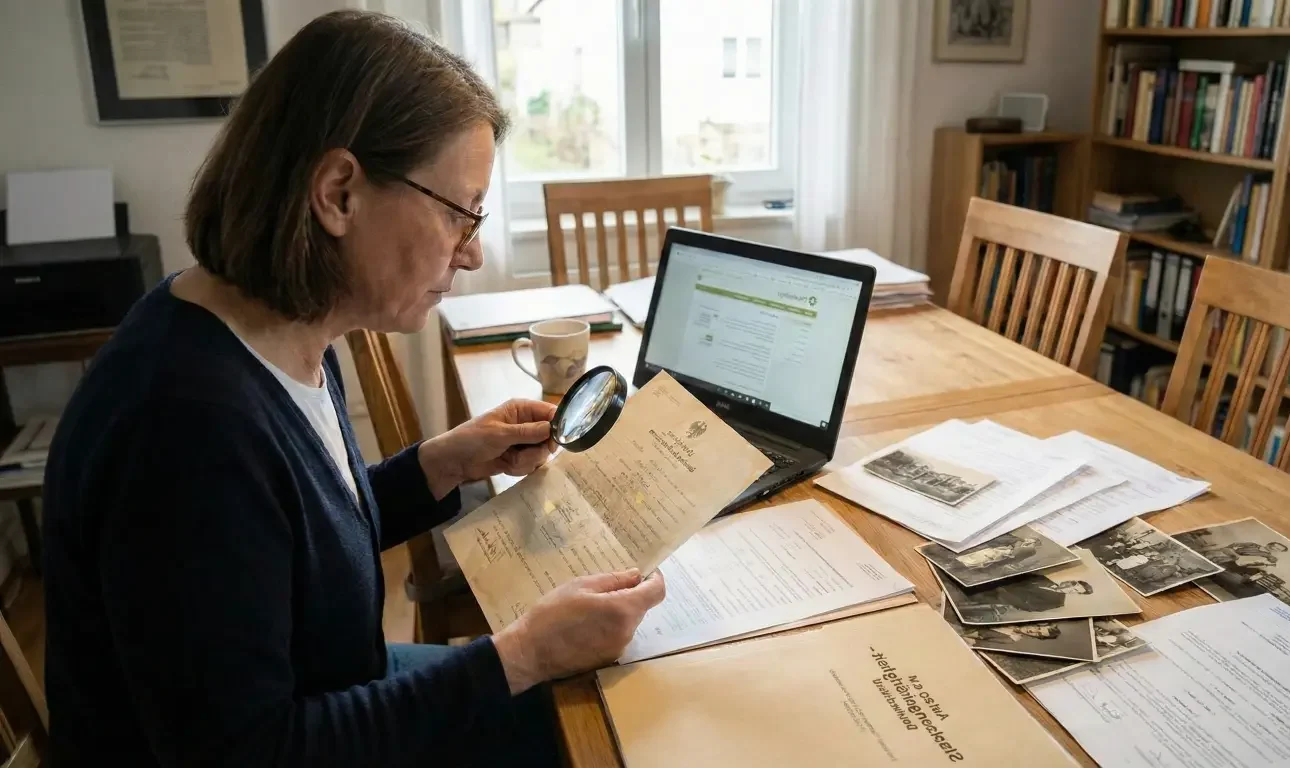
Most people don’t lose time on the “citizenship rules”—they lose time on citizenship by descent documents paperwork logistics.
If you’re pursuing citizenship by descent, you’ve probably had the same thought many applicants do at the beginning: The documents should be straightforward. Birth certificates, marriage certificates, maybe a death record, done. Then reality hits. One missing record turns into three requests. One “official” certificate turns out to be the wrong format. A name mismatch that seemed harmless becomes a submission-stopper. And suddenly you’re stalled before you can even submit.
This guide is designed to help you spot the real choke points early, so you can build a document plan that moves forward instead of looping. It’s process-first, not country-specific—because requirements vary—but the bottlenecks tend to rhyme across jurisdictions.
The real problem: citizenship-by-descent cases don’t fail first on law—they stall on documentation flow
A documentation bottleneck usually doesn’t look dramatic. It looks like “waiting.”
- Waiting for a records office to respond.
- Waiting because you received a certificate, but you’re not sure it’s acceptable.
- Waiting because you translated something and then learned the destination authority needed a different format.
- Waiting because a small discrepancy triggered a bigger question: Do I need to amend this record?
What makes this uniquely frustrating is that it’s not one delay—it’s a chain reaction. If you treat your document collection as a single task (“gather documents”), you’ll get stuck repeatedly. If you treat it as a flow (“request → receive → verify → correct → legalize → translate → assemble”), you can prevent the most common loops.
The goal isn’t to move faster. It’s to rework less.
The documentation funnel (the steps where most people drop off)
Here’s the typical documentation funnel for citizenship by descent documents. Even if your destination country uses different names for these steps, the underlying flow is often the same:
- Request
- Receive
- Verify (is it the right document, in the right format?)
- Correct (fix mismatches, re-request, amend if required)
- Legalize (often via apostille or another legalization method)
- Translate (if documents aren’t in the submission language)
- Assemble (package everything as a coherent, consistent set)
- Submit
Two important notes:
- The order matters. Whether legalization happens before translation (or the reverse) can depend on the destination authority’s rules. If you guess the sequence, you risk paying twice.
- Verification is where momentum is won or lost. Most delays trace back to a document that should have been flagged the day it arrived.
If you’ve been stalled, it’s usually because one of these steps was skipped or done out of sequence—not because you’re “missing effort.”
Bottleneck #1 — Vital records that aren’t acceptable (even when they’re “official”)
This is the most common early derailment: you receive a birth or marriage certificate and assume it’s acceptable because it’s official. Then you find out the destination authority requires a different version or a different issuing office.
Common failure modes
These are the patterns that cause re-requests and months of delay:
- Short-form vs. long-form versions. Some jurisdictions issue multiple certificate formats. One may be intended for informal use, while another includes full details (parents’ names, annotations, registration details). If the submission authority expects full details and you ordered the short version, you’ll need to re-order.
- Uncertified copies. You might receive an informational copy, a printout, or a copy that’s not certified in the way the destination authority expects.
- Wrong issuing authority. A document can be “real” but still not acceptable if it didn’t come from the required office or registry.
- Missing marginal notes or annotations. In some systems, important updates (like corrections or legal status notes) appear as annotations. If they’re missing, the record may be considered incomplete.
- Poor legibility or incomplete pages. Scans can cut off seals, stamps, or registration fields—exactly the details that prove authenticity.
None of these issues mean your case is weak. They mean your document version control needs tightening.
Fast checks the day the document arrives
Before you spend money on legalization or translation, do a quick “arrival inspection.” You’re trying to answer one question: Is this document acceptable enough to invest in next steps?
Use these checks as a practical starting point (your destination authority may have additional requirements):
- Completeness: Does it include all fields you’d expect for identity alignment (names, dates, places)? Does it include full registration details if available?
- Identifiers: Are names spelled consistently? Are there accent marks, multiple surnames, or middle names that differ from other records in your chain?
- Authenticity markers: Does it include seals, stamps, signatures, or official registration markings typical of certified documents?
- Issuing office clarity: Is the issuing authority clearly identified (not just a website printout or a third-party summary)?
- Date/version: Is it a current certified copy if the process expects a recent issuance?
If anything looks off, pause before you “process” the document further. A rejected document at this stage is cheap. A rejected document after translation and legalization is expensive.
Bottleneck #2 — Mismatches across generations (names, dates, places) and how they cascade
This is where many applicants feel blindsided. You may have the correct records—but they don’t line up cleanly across generations.
A mismatch isn’t automatically fatal. The problem is what mismatches can trigger: questions about identity continuity and the relationship chain. The more generations involved, the more likely you’ll see variation.
Here are the mismatches that commonly cause stalls:
- Name variations: spelling differences, missing middle names, different ordering, double surnames appearing differently across documents
- Place variations: a town listed one way on one document and another way on a different document (or a region name instead of a city)
- Date differences: day/month transpositions, approximations, or late registrations
- Marital status or parental details: missing parent names, inconsistent mother’s maiden name, or different surname usage after marriage
The cascade happens like this:
- You request a record.
- It arrives.
- You discover it doesn’t match another record.
- Now you’re unsure whether you can submit as-is, need supporting evidence, or need an amendment.
- Everything downstream (legalization, translation, assembly) pauses.
Practical steps: build a “discrepancy map” before you decide on corrections
Instead of reacting mismatch-by-mismatch, build one simple tool: a discrepancy map.
Make a table with:
- Document name
- Person name as written
- DOB as written
- Place as written
- Parents/spouse names
- Notes on differences
Then mark each difference as:
- Cosmetic (formatting or common variation)
- Material (could raise identity continuity questions)
- Unknown (needs review against destination requirements)
This approach does two things:
- It prevents you from repeatedly discovering new mismatches late in the process.
- It makes professional review far more efficient if you decide to seek it.
If you’re stuck right now, it’s often because you’re trying to solve mismatches in real time as they appear. Mapping them upfront helps you decide what truly needs correction versus what can be explained with consistent documentation.
Bottleneck #3 — Apostilles/legalization: where timing and format quietly break the process
Legalization is where paperwork begins to feel like a maze. Many applicants assume legalization is a single stamp step that can be handled at the end. In practice, it can be the point where a file loops back to the beginning.
Here’s what people often assume:
- “I’ll gather everything first, then apostille everything at once.”
- “I can apostille any copy as long as it’s official.”
- “It doesn’t matter whether I translate first or apostille first.”
What often happens instead:
- The destination authority expects a specific document type to be legalized, not an informational copy.
- The legalization authority requires the document to be issued or certified in a particular way before it can be legalized.
- You translate too early or legalize too early and have to redo one step because the sequence wasn’t aligned to requirements.
Because legalization procedures vary by jurisdiction and destination, the safest operational rule is this:
Before you spend money on legalization, confirm (1) which exact document versions must be legalized and (2) whether legalization must occur before translation for your destination authority.
How to avoid paying twice: sequence planning, batching, and document lifecycle
A simple way to reduce rework is to treat each document like it has a lifecycle:
- Stage 1: Raw arrival (received from issuing authority)
- Stage 2: Verified (confirmed acceptable version/format)
- Stage 3: Process-ready (cleared for legalization and/or translation)
- Stage 4: Finalized (legalized/translated as required)
- Stage 5: Packaged (assembled with consistent names and supporting notes)
Batching works best at Stage 3. If you batch earlier, you risk processing the wrong version. If you batch later, you may lose time waiting on the slowest document.
If you’re stuck on apostilles right now, it often means the “verified” step wasn’t fully completed—or the expected sequence wasn’t confirmed before money and time were committed.
Bottleneck #4 — Translations that get rejected (format, certification, or scope issues)
Translation feels like a straightforward service: send document, get translation. The problem is that “a translation” isn’t always “an acceptable translation.”
Rejections tend to happen because requirements are specific about:
- who can translate
- how the translation is certified
- whether the translation must mirror formatting
- whether names and places must be standardized in a particular way
- whether the translation should include stamps, marginal notes, or handwritten annotations
What to clarify before translating
Before you commission translations, clarify these points for your destination authority (or phrase it safely if you don’t have confirmed rules yet):
- Certification standard: Does the destination authority require a certification statement, sworn translator, or notarization? Requirements vary.
- Scope: Must stamps, seals, annotations, and marginal notes be translated?
- Formatting expectations: Must the translation mirror the layout, or is a standard typed translation acceptable?
- Name consistency rules: How should you handle accent marks, double surnames, or variations between documents?
- Sequence: Confirm whether documents should be legalized before translation or translation before legalization, depending on requirements.
If you translate first and later discover legalization had to occur first (or the document version was wrong), you’ll likely pay twice.
How to reduce redo risk: a translation brief and consistency rules
One practical move that separates smooth applications from stalled ones: write a simple translation brief.
Include:
- The submission purpose: citizenship by descent application
- The destination language of submission
- A name consistency sheet: exact spelling you want used across documents (with notes on accent marks or surname order)
- A note to translate all stamps/annotations unless explicitly excluded
- A request to flag unclear handwriting or ambiguous terms rather than guessing
This is not about micromanaging translation. It’s about preventing accidental inconsistencies that later look like identity mismatches.
The “contrarian” moment: the fastest applicants don’t move faster—they rework less
If you’ve been stalled, it can feel like the solution is to push harder—more calls, more requests, more shipping, more “get it done.”
But the applicants who move through smoothly usually do one thing differently: they reduce loops.
They don’t translate documents until the document version is verified.
They don’t legalize documents until they’ve confirmed which versions must be legalized.
They don’t treat mismatches as isolated annoyances—they map them early and decide what matters.
It’s less sprinting, more sequencing.
If you take just one mindset shift from this article, make it this:
Every time you process a document (translate, legalize, amend), you’re placing a bet that it’s the right version. Verification is how you stop betting blindly.
A practical pre-submission checklist to keep your file moving
Below is a process checklist you can use as a working system. It’s not a country-specific list of documents; it’s a system for preventing stalls.
1) Build your document inventory
Create a master inventory that includes:
- Document name (birth, marriage, death, etc.)
- Person and generation (you, parent, grandparent, etc.)
- Issuing jurisdiction and office
- Status: Requested / Received / Verified / Needs correction / Ready for legalization / Legalized / Ready for translation / Translated / Packaged
- Notes (mismatches, missing fields, questions)
This becomes your control center. Without it, you’ll keep losing time rediscovering what you already learned.
2) Verify before you process
For every document you receive, do a quick verification step:
- Is this the correct format/version?
- Is it clearly issued by the correct authority?
- Are the key identity details complete?
- Does it introduce a mismatch with other records?
If you find an issue, pause and decide whether it requires:
- a re-request (different certificate type)
- a correction/amendment
- supporting documentation
- or a consistent explanation in your package
3) Standardize names and places
Create a simple “standardization sheet”:
- Preferred spelling of each person’s full name
- Notes on accent marks and surname order
- Place names (consistent usage)
- A record of known variations that appear in documents
This reduces translation inconsistencies and helps you assemble a clean package.
4) Plan legalization and translation as a controlled batch
Once documents are verified, plan:
- Which documents will be legalized
- Which documents will be translated
- What the sequence should be (confirm per destination authority when possible)
Batching verified documents reduces time without increasing redo risk.
5) Package with version control
Treat your file like a submission packet, not a pile of papers:
- Keep a digital folder with clear file naming (e.g., GEN2_Grandparent_BirthCertificate_Certified_YYYYMMDD)
- Store originals safely and track which copies were used for which step
- Maintain a simple log of actions: requested, received, processed, re-requested
If your case spans multiple months, this prevents confusion and duplicated costs.
Proof posture — how to verify you’re not building on weak documents
Because requirements vary, “proof posture” here means: how to validate your document plan before you commit money and time to irreversible steps.
Here are the evidence checks that protect you:
- Acceptability criteria: Confirm which versions of vital records are acceptable for your destination authority (long-form vs short-form, certified vs informational). If you can’t confirm, use conservative wording internally and avoid processing questionable versions.
- Issuing authority confirmation: Verify that the issuing office is the one the destination authority expects.
- Legalization sequence: Confirm whether apostille/legalization should occur before translation or translation before legalization. If unclear, treat this as a high-risk assumption and avoid committing funds until clarified.
- Translation acceptance requirements: Confirm certification format, translator qualifications, and whether annotations must be translated.
- Submission standard for copies: Determine whether scans/photocopies are ever acceptable and at what stage.
When professional review is worth it (without guarantees)
You don’t necessarily need full representation to benefit from expert eyes. A focused review can be useful when:
- you’ve mapped multiple mismatches and aren’t sure what requires correction
- you’ve received documents but don’t know if they’re the acceptable versions
- you’re about to spend significantly on legalization and translation and want to reduce redo risk
The value of review isn’t speed. It’s avoiding a “wrong turn” that costs months.
Next step: get your documentation plan reviewed before you spend another month
If your process is stalled on vital records, apostilles, or translations, you don’t need more guessing—you need a document plan.
Share what you have and what you’re missing, and we’ll help you identify the likely bottlenecks before you spend time and money twice.
Get a Free Case Evaluation to map your documentation path and next steps.
FAQ
What documents are usually required for citizenship by descent applications?
It depends on the destination authority and your family chain, but many applications revolve around vital records that prove identity and family relationships across generations. The key isn’t just having documents—it’s having the acceptable versions in the right format, with consistent details across the chain.
Why do “official” birth or marriage certificates get rejected?
Because “official” doesn’t always mean “acceptable.” Rejections often happen when the certificate is the wrong version (for example, a short form instead of a full-detail version), isn’t certified as required, comes from the wrong issuing authority, or is missing annotations the submission authority expects.
Do I need apostilles before translating my documents?
The correct sequence depends on the destination authority’s rules. Some processes expect legalization first, others may expect translation first, and some may have specific requirements for both. The safest approach is to confirm the sequence before paying for translation or legalization to avoid rework.
How do name differences across generations affect the application?
Name differences can create questions about identity continuity and relationship links. Some variations are common and manageable, but others may trigger requests for corrections, supporting documents, or clarifications. Mapping discrepancies early helps you decide what truly needs correction versus what can be consistently explained.
What makes a translation acceptable for citizenship by descent paperwork?
Translation requirements vary. Common acceptance issues include missing certification language, using an unqualified translator (if qualifications are required), failing to translate stamps or annotations, or introducing inconsistent spellings of names and places. It helps to clarify requirements before translating and provide a consistency sheet to reduce errors.
How can I organize and track citizenship by descent documents to avoid rework?
Use a simple document tracker with statuses like Requested, Received, Verified, Needs correction, Legalized, Translated, and Packaged. Standardize file naming, keep a log of actions taken, and verify documents before paying for legalization or translation. The goal is to reduce loops and prevent costly redo work.
If your case is stuck on records, apostilles, or translations, you don’t need more guessing—you need a document plan.