
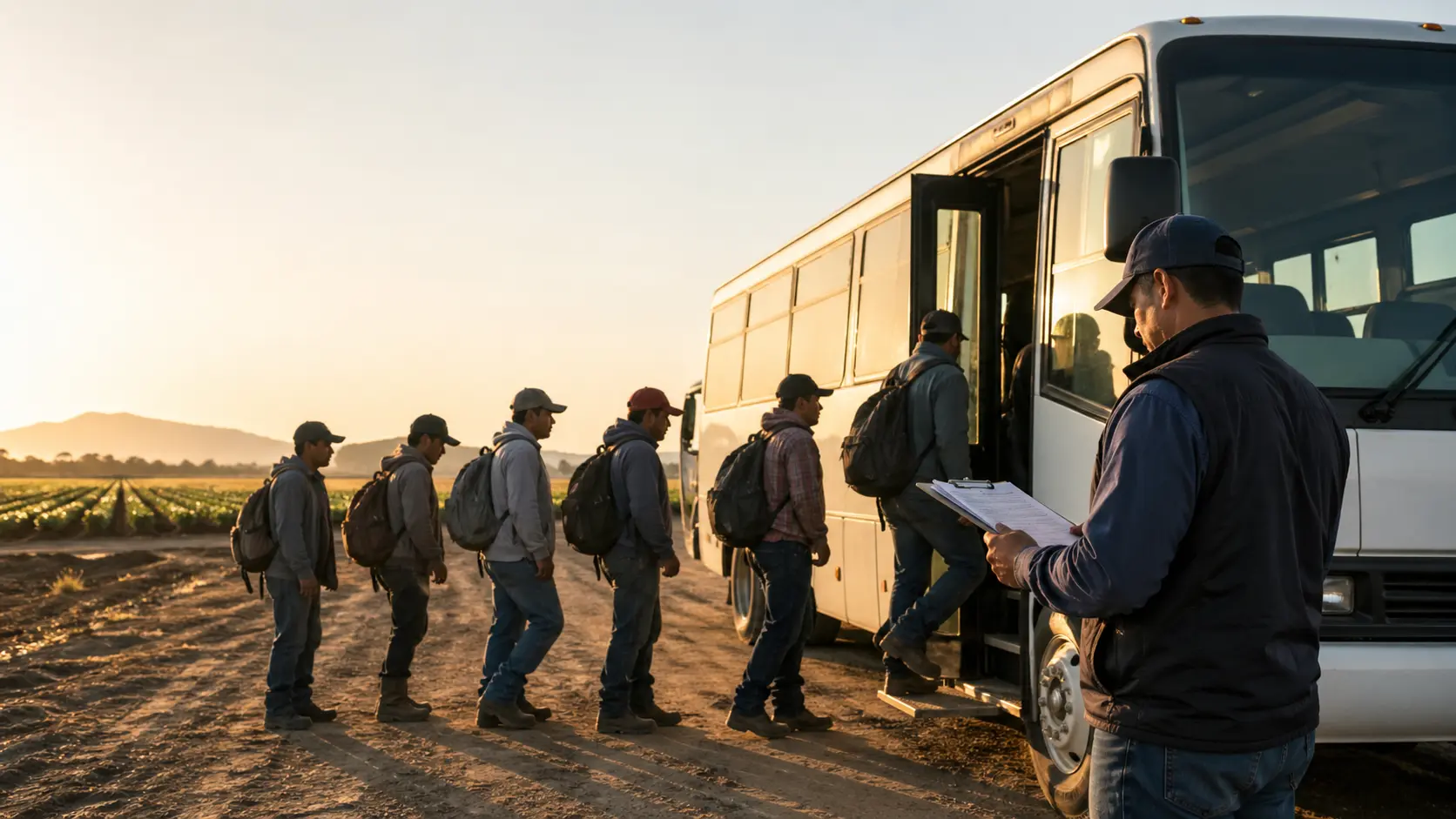
Transportation can look resolved on paper long before it is truly defensible in practice. A vendor has vehicles. Drivers show up. Workers get from housing to the worksite. Operations move. From the outside, that can create a false sense of closure.
But H-2A transportation oversight is rarely just about whether a ride exists. For employers, the harder question is whether the transportation arrangement would hold up under real scrutiny if an audit, complaint, incident, or internal review forces people to look closely. That is where gaps tend to surface. Not because no one cared, but because the oversight process was thinner than the risk required.
When employers work with H-2A transportation vendors, the exposure often comes from assumptions. Someone assumes the vendor’s authorization is current. Someone assumes the insurance file is enough. Someone assumes that because transport has been happening without visible issues, the arrangement is compliant. By the time those assumptions get tested, the season may already be underway.
Why transportation oversight becomes a compliance issue faster than many employers expect
Transportation sits in an awkward place operationally. It feels logistical, so it gets managed like logistics. Schedules, routes, housing locations, worker count, and pickup timing often take priority. Those things matter, of course, but they can crowd out the quieter compliance questions that deserve equal attention.
That is especially true in H-2A settings, where employers may already be balancing housing, recruitment timing, job order requirements, workforce planning, and vendor coordination all at once. In that environment, transportation oversight can become a box that was “handled” during setup instead of a control point that needs to stay active during the season.
The problem is that transportation risk does not wait for a major event to become real. A document can expire. A route can change. A subcontractor can appear informally. A vehicle can be swapped. A driver can rotate in. A housing arrangement can shift. Each change may look small on its own, but together they can create a mismatch between what the employer thinks is happening and what could actually be supported if someone asks for proof.
Misconception 1: If the vendor handles transportation, the compliance burden moves with them
This is the misconception that creates the most dangerous calm.
When an employer hires a transportation vendor, it is natural for internal teams to assume that the vendor owns the transportation problem. In practical terms, the vendor may handle dispatch, vehicles, drivers, and daily movement. But operational delegation and compliance insulation are not the same thing.
For H-2A employers, the more useful mindset is this: using a vendor may change who performs the transportation, but it does not remove the need to verify that the arrangement satisfies the transportation obligations tied to the program and the actual worksite setup. If the employer’s team treats vendor involvement as the end of review rather than the beginning of oversight, that is usually when gaps survive unnoticed.
This matters because employers often discover too late that they were relying on a service relationship where responsibilities were functionally blurred. The vendor thought the employer was tracking one part of the obligation. The employer thought the vendor was. No one built a review step strong enough to test the handoff.
Misconception 2: A certificate of insurance and a contract clause are enough
Document collection feels reassuring because it creates a file. But a file is not the same thing as oversight.
It is common for employers to keep a contract, a certificate of insurance, and a point of contact on hand and treat that packet as proof that transportation risk has been addressed. The problem is that those documents usually answer only a narrow question: did something exist at one point in time? They do not automatically answer whether the transportation arrangement is still aligned with actual operations, current obligations, and the people and vehicles being used right now.
Why document collection is not the same as oversight
A transportation file may look complete while still leaving core questions unresolved:
- Does the paperwork match the specific transportation model being used in the field?
- Is the vendor actually authorized for the activities it is performing?
- Are the vehicles and drivers in use the same ones reflected in the employer’s review process?
- Does the agreement clearly assign operational responsibilities without creating blind spots in verification?
An employer can have paperwork on hand and still be unable to answer those questions confidently. That is usually the sign that the file was built for procurement comfort, not for compliance readiness.
What changes during the season can quietly create exposure
Mid-season drift is one of the most common reasons a transportation arrangement becomes harder to defend than expected.
Maybe worker housing changes because the original setup no longer fits. Maybe transportation demand increases and the vendor substitutes vehicles. Maybe the original driver is unavailable and another person steps in. Maybe route timing changes in a way that creates new pickup or wait conditions. None of these changes sounds dramatic. But in a compliance review, they can matter because the real-world arrangement has moved beyond what the employer originally reviewed.
That is why one-time onboarding is rarely enough. If the oversight process never revisits transportation after startup, it can miss the exact changes that create late-stage audit problems.
Misconception 3: Safe-looking vehicles mean the transportation program is defensible
Visual impressions can be misleading. A clean vehicle, a professional driver, and an orderly pickup process may reduce operational anxiety, but they do not by themselves prove that the transportation program is being managed in a defensible way.
Employers usually need a broader view. Transportation oversight is not just about appearances or even about the ride itself. It is also about whether the arrangement meets the applicable standards, whether the supporting records exist, whether the responsible parties are properly qualified, and whether the employer can show a real oversight process instead of a passive reliance model.
This is where transportation gets misunderstood as a fleet issue when it is really a control issue. The strongest employers do not just ask whether transportation is happening. They ask whether they could explain, document, and support how it is happening.
The compliance gaps employers usually find too late
The late-stage problems are usually not mysterious. They tend to fall into a few recurring categories.
Authorization and registration gaps
One common gap is assuming that because a vendor has worked in agricultural settings before, the relevant authorization or registration questions must already be resolved. In practice, employers often need a more specific review. If transportation-related authorization matters for the contractor structure involved, that status should be verified directly and revisited when the arrangement changes.
This is also where employers can get tripped up by informal layering. A company they reviewed may not be the only entity actually touching the transportation process. If another party is involved behind the scenes, the employer may not notice until someone asks who is really providing the service and under what authority.
Driver, vehicle, and safety-standard gaps
Another late discovery is that the transportation setup looked stable, but the proof trail around drivers, vehicles, safety standards, or insurance was incomplete, outdated, or too general to be useful.
In real operations, employers may only discover the weakness when they need to answer a pointed question: Which vehicles were used? Which drivers were assigned? Was the supporting documentation current? Was the arrangement reviewed against the applicable safety expectations, or did everyone simply assume the vendor handled it?
The issue is often not one missing piece. It is the absence of a review system that ties those pieces together.
Route, housing, and daily transportation gaps
Transportation obligations are not always limited to a simple vendor pickup concept. In H-2A settings, the relationship between housing, worksite access, route design, and daily transportation can create exposure when employers treat transportation as a generic shuttle issue rather than part of the broader worker arrangement.
For example, a route that makes sense operationally may still raise questions if it does not line up cleanly with how housing and daily transportation responsibilities are being managed. If workers are moved, housing changes, or worksite patterns shift, transportation oversight should move with those changes. Too often, it does not.
Recordkeeping and proof gaps
The final category is proof. Even when an employer made thoughtful decisions, the documentation trail may be too weak to demonstrate that the oversight actually happened.
That can show up in simple ways: no dated review process, no periodic re-check, no clear internal owner, no record of what was verified, no escalation notes when conditions changed. In other words, the employer may have been trying to do the right thing without creating the kind of record that makes the effort visible later.
That gap matters because in a review setting, undocumented oversight often gets treated much like missing oversight. The employer may remember what was checked, but memory is not a system.
What a stronger vendor oversight process looks like before an audit or complaint
A stronger process does not need to be elaborate to be useful. It needs to be deliberate, current, and tied to how transportation is actually operating.
At a practical level, employers often benefit from structuring transportation review around a few recurring questions:
- What transportation obligations are we actually responsible for in this case?
- Which entity is performing each part of the transportation arrangement?
- What documentation supports that setup today, not just at onboarding?
- What would trigger a re-review during the season?
- Who inside the employer organization owns the follow-through?
This kind of framework changes the conversation. Instead of asking whether the vendor is “good,” the employer begins asking whether the arrangement is verifiable. That is a much stronger compliance question.
It also helps to treat transportation as part of a broader H-2A operating environment. Housing, daily movement, vendor coordination, worker logistics, and internal case management should not sit in separate silos if they affect one another in practice.
Questions employers should ask before transport starts, not after a problem
The best time to pressure-test a vendor is before transportation becomes routine.
Useful questions may include:
- What transportation responsibilities are we expecting this vendor to handle?
- What documents or authorizations support those activities?
- How will we verify that the drivers, vehicles, and operating model in use match what was reviewed?
- What happens if the vendor substitutes vehicles, rotates drivers, or changes routing?
- How will we document re-checks during the season?
- If there is an incident, complaint, or audit question, who can produce the underlying support quickly?
These are not trick questions. They are operating questions. When a vendor relationship cannot answer them clearly, that usually signals a need for tighter review before transport begins.
How to build a practical review rhythm during the season
Many employers do not need a bigger compliance binder. They need a repeatable rhythm.
That rhythm might be simple: an initial pre-launch review, a mid-season verification point, and an event-triggered review whenever housing, routes, driver assignments, vehicles, or vendor structure changes. The key is not frequency for its own sake. The key is making sure transportation oversight reflects operational reality rather than a stale file.
It also helps to assign ownership internally. When transportation touches operations, HR, housing coordination, and immigration case support, responsibility can diffuse quickly. A named owner or review lead makes it much more likely that changes will be surfaced and documented instead of absorbed quietly.
Finally, employers should think in terms of escalation, not just collection. If a gap appears, what happens next? Does transport pause? Does the vendor have to cure the issue? Does counsel or a compliance advisor review the situation? A good review rhythm includes a path for acting on what the review finds.
When a consultation makes sense
Some employers can improve transportation oversight internally with a clearer checklist and better ownership. Others benefit from outside review, especially when transportation is already active, the season is moving quickly, or multiple vendors and housing arrangements are involved.
A consultation can be useful when the core question is not “what is H-2A?” but “does our actual transportation setup hold together under scrutiny?” That is a different level of review. It looks at how contracts, field practice, documentation, and program obligations line up in the real world.
If your current transportation arrangement feels settled mainly because no one has challenged it yet, that is often a good moment to pressure-test it. Request a consultation to review whether vendor oversight, supporting documents, and day-to-day operations are aligned before a gap turns into an audit or incident problem.
Frequently asked questions about H-2A transportation vendors
Are employers still responsible if an H-2A transportation vendor handles the driving?
Employers should be careful not to assume that vendor involvement removes the need for direct oversight. A safer working approach is to verify how transportation responsibilities are being met and documented rather than treating delegation as a full transfer of risk.
What documents should employers review before using an H-2A transportation vendor?
That depends on the transportation model and the responsibilities involved, but employers generally benefit from reviewing the documentation, authorization, and operating details that support the vendor’s actual role, then revisiting them when the arrangement changes.
Do H-2A transportation vendors need special authorization or registration?
In some situations, contractor status and transportation-related authorization can matter. Employers should verify the vendor’s status directly where relevant instead of relying on assumptions or past experience.
What transportation records should an employer keep during the season?
Employers usually need more than a startup file. A practical record set should reflect what was reviewed, when it was reviewed, what changed during the season, and how those changes were evaluated.
How often should transportation vendors be reviewed during an H-2A season?
A useful approach is to review before launch, revisit mid-season, and re-check whenever material changes affect routes, housing, vehicles, drivers, or vendor structure. The right cadence depends on the operating complexity, but one-time review is often too thin.
When should an employer ask for outside compliance support?
Outside support can make sense when transportation is already running, documentation feels fragmented, multiple parties are involved, or internal teams are not confident that operational practice matches program obligations. A targeted review is often easier before a complaint, incident, or audit question forces one.
If transportation already feels “covered,” this is exactly when a pressure-test can be useful. A focused review can help you see whether vendor paperwork, operational reality, and H-2A obligations actually line up. Request a consultation to identify the gaps that are easier to fix before they turn into an audit or incident problem.
RELATED LINK:
U.S. Department of Labor — H-2A Employer’s Guide to the Final Rule
“Improving Protections for Workers in Temporary Agricultural Employment in the United States”